
Newspaper clippings · March 20, 1994
Los Angeles Times — Plain Talk Cuts Through Fog on County Budget
Bill Boyarsky column on Los Angeles County budget policy.
Text
Transcribed from the scans and checked against them by Claude. Typed text comes first; handwritten notes follow it. [illegible] marks words that cannot be read and [?] an uncertain reading.
Page 1
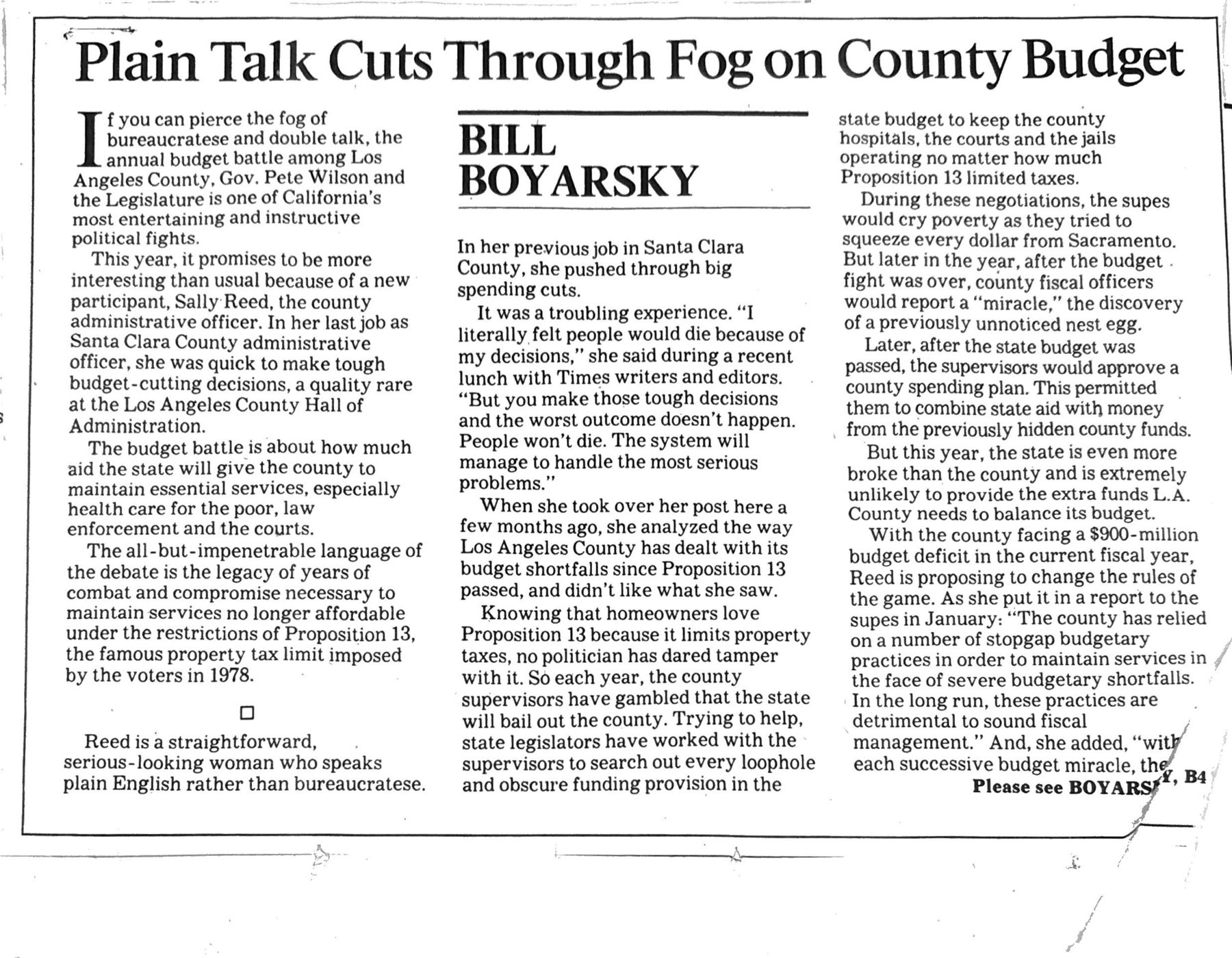
Plain Talk Cuts Through Fog on County Budget
If you can pierce the fog of bureaucratese and double talk, the annual budget battle among Los Angeles County, Gov. Pete Wilson and the Legislature is one of California's most entertaining and instructive political fights.
This year, it promises to be more interesting than usual because of a new participant, Sally Reed, the county administrative officer. In her last job as Santa Clara County administrative officer, she was quick to make tough budget-cutting decisions, a quality rare at the Los Angeles County Hall of Administration.
The budget battle is about how much aid the state will give the county to maintain essential services, especially health care for the poor, law enforcement and the courts.
The all-but-impenetrable language of the debate is the legacy of years of combat and compromise necessary to maintain services no longer affordable under the restrictions of Proposition 13, the famous property tax limit imposed by the voters in 1978.
Reed is a straightforward, serious-looking woman who speaks plain English rather than bureaucratese.
BILL BOYARSKY
In her previous job in Santa Clara County, she pushed through big spending cuts.
It was a troubling experience. "I literally felt people would die because of my decisions," she said during a recent lunch with Times writers and editors. "But you make those tough decisions and the worst outcome doesn't happen. People won't die. The system will manage to handle the most serious problems."
When she took over her post here a few months ago, she analyzed the way Los Angeles County has dealt with its budget shortfalls since Proposition 13 passed, and didn't like what she saw.
Knowing that homeowners love Proposition 13 because it limits property taxes, no politician has dared tamper with it. So each year, the county supervisors have gambled that the state will bail out the county. Trying to help, state legislators have worked with the supervisors to search out every loophole and obscure funding provision in the state budget to keep the county hospitals, the courts and the jails operating no matter how much Proposition 13 limited taxes.
During these negotiations, the supes would cry poverty as they tried to squeeze every dollar from Sacramento. But later in the year, after the budget fight was over, county fiscal officers would report a "miracle," the discovery of a previously unnoticed nest egg.
Later, after the state budget was passed, the supervisors would approve a county spending plan. This permitted them to combine state aid with money from the previously hidden county funds.
But this year, the state is even more broke than the county and is extremely unlikely to provide the extra funds L.A. County needs to balance its budget.
With the county facing a $900-million budget deficit in the current fiscal year, Reed is proposing to change the rules of the game. As she put it in a report to the supes in January: "The county has relied on a number of stopgap budgetary practices in order to maintain services in the face of severe budgetary shortfalls. In the long run, these practices are detrimental to sound fiscal management." And, she added, "with each successive budget miracle, the
Please see BOYARSKY, B4
Page 2
YARSKY: Plain Talk Cuts Through Fog on County Budget
Continued from B1
credibility of the county's fiscal plight has been damaged. This has undermined our advocacy effort in Sacramento."
She proposed making big cuts now, and passing the county budget by June 17 without waiting for the state to bail out L.A. County.
"This will demonstrate that the board has taken all steps necessary to move the county toward establishing fiscal stability within its own means," she told the board. "Any relief from Sacramento cannot be relied upon at this time."
But there's another side of the story, and it was heard last Tuesday when Reed brought the supervisors her proposal to pass the budget in June.
Among the hundreds of thousands of people dependent on county services are mentally ill men, women and children cared for in nonprofit centers that are partially financed by county funds. As private donations dwindled during the recession, the county money became more important to the survival of these psychiatric care facilities.
On Tuesday, Richard Van Horn, chief executive officer of the Mental Health Assn. of Los Angeles County, sat in the audience in the board's hearing room, along with Gloria Nebrit, who heads the Kedren mental health center in South-Central Los Angeles.
Kedren provides care to about 3,000, she said. She and Van Horn said they opposed the Reed strategy. They wanted a vote on the county budget delayed until the state acted. They were confident they could persuade legislators that the mental health centers were worthwhile enough to deserve a bailout.
They proved more persuasive than Reed, whose plan was defeated 3 to 2 by the supervisors.
"It is my experience that they are a very powerful lobby, so we ought to give them a chance before we cut these mental health programs," said Yvonne Brathwaite Burke, the Board of Supervisors chairwoman.
It was a defeat for Reed. Once again, the board refused to come to grips with Proposition 13. But because of Reed, at least we know what's going on. Los Angeles County is not living within its limited income.
Handwritten notes
• (top left corner) [illegible] 3/11/94[?]
Show the original machine reading
Source scan page 4
Plain Talk Cuts Through Fog on County Budget
f you can pierce the fog of bureaucratese antid ame call, the
annual budget battle among Los
Angeles County, Gov. Pete Wilson and
the Legislature is one of California's
most entertaining and instructive
political fights.
This year, it promises to be more
interesting than usual because of a new
participant, Sally Reed, the county
administrative officer. In her last job as
Santa Clara County administrative
officer, she was quick to make tough
budget-cutting decisions, a quality rare
at the Los Angeles County Hall of
Administration.
The budget battle is about how much
aid the state will give the county to
maintain essential services, especially
health care for the poor, law
enforcement and the courts.
The all-but-impenetrable language of
the debate is the legacy of years of
combat and compromise necessary to
maintain services no longer affordable
under the restrictions of Proposition 13,
the famous property tax limit imposed
by the voters in 1978.
BILL
Reed is a straightforward,
serious-looking woman who speaks
plain English rather than bureaucratese.
BOYARSKY
In her previous job in Santa Clara
County, she pushed through big
spending cuts.
It was a troubling experience. "I
literally felt people would die because of
my decisions," she said during a recent
lunch with Times writers and editors.
"But you make those tough decisions
and the worst outcome doesn't happen.
People won't die. The system will
manage to handle the most serious
problems."
When she took over her post here a
few months ago, she analyzed the way
Los Angeles County has dealt with its
budget shortfalls since Proposition 13
passed, and didn't like what she saw.
Knowing that homeowners love
Proposition 13 because it limits property
taxes, no politician has dared tamper
with it. So each year, the county
supervisors have gambled that the state
will bail out the county. Trying to help,
state legislators have worked with the
supervisors to search out every loophole
and obscure funding provision in the
state budget to keep the county
hospitals, the courts and the jails
operating no matter how much
Proposition 13 limited taxes.
During these negotiations, the supes
would cry poverty as they tried to
squeeze every dollar from Sacramento.
But later in the year, after the budget
fight was over, county fiscal officers
would report a "miracle," the discovery
of a previously unnoticed nest egg.
Later, after the state budget was
passed, the supervisors would approve a
county spending plan. This permitted
them to combine state aid with money
from the previously hidden county funds.
But this year, the state is even more
broke than the county and is extremely
unlikely to provide the extra funds L.A.
County needs to balance its budget.
With the county facing a $900-million
budget deficit in the current fiscal year,
Reed is proposing to change the rules of
the game. As she put it in a report to the
supes in January: "The county has relied
on a number of stopgap budgetary
practices in order to maintain services in
the face of severe budgetary shortfalls.
In the long run, these practices are
detrimental to sound fiscal
management." And, she added, "with
each successive budget miracle, the
Please see BOYARS Y, B4
Source scan page 5
YARSKY: Plain Talk Cuts Through Fog on County Budget
Continued from B1
credibility of the county's fiscal plight has been damaged. This has undermined our advocacy effort in Sacramento." She proposed making big cuts now, and passing the county budg-
et by June 17 without waiting for
the state to bail out L.A. County.
"This will demonstrate that the
board has taken all steps necessary
to move the county toward estab-
lishing fiscal stability within its
own means," she told the board.
"Any relief from Sacramento can-
net be relied upon at this time."
But there's another side of the
story, and it was heard last Tues-
day when Reed brought the super-
visors her proposal to pass the
budget in June. Among the hundreds of thou-
sands of people dependent on
county services are mentally ill
men, women and children cared for
in nonprofit centers that are par-
tially financed by county funds. As
private donations dwindled during
the recession, the county money
became more important to the
survival of these psychiatric care
facilities.
On Tuesday, Richard Van Horn,
chief executive officer of the Men-
tal Health Assn. of Los Angeles
County, sat in the audience in the
board's hearing room, along with
Gloria Nebrit, who heads the Ked-
ren mental health center in South-
Central Los Angeles.
Kedren provides care to about
3,000, she said. She and Van Horn
said they opposed the Reed strate-
gy. They wanted a vote on the
county budget delayed until the
state acted. They were confident
they could persuade legislators
that the mental health centers
were worthwhile enough to de-
serve a bailout.
They proved more persuasive
than Reed, whose plan was defeat-
ed 3 to 2 by the supervisors.
"It is my experience that they
are a very powerful lobby, so we
ought to give them a chance before
we cut these mental health pro-
grams," said Yvonne Brathwaite
Burke, the Board of Supervisors
chairwoman.
It was a defeat for Reed. Once
again, the board refused to come to
grips with Proposition 13. But be-
cause of Reed, at least we know
what's going on. Los Angeles
County is not living within its
limited income.