
Newspaper clippings · October 28, 1993
Beach Reporter — Council candidates debate police and revenue
Kalle Matso reports a candidate debate about city finance and public services. Included for civic context.
Part of this item is hard to read or covered in the scan. A clearer copy is being sought.
Text
Transcribed from the scans and checked against them by Claude. Typed text comes first; handwritten notes follow it. [illegible] marks words that cannot be read and [?] an uncertain reading.
8 • The Beach Reporter • October 28, 1993
Hermosa Beach
City Council candidates debate police and revenue issues
by Kalle Matso
The 12 candidates vying for three Hermosa Beach City Council seats met for the second time Monday to debate issues before the municipal election to be held on Nov. 2.
With the relatively large field of candidates, the League of Women Voters moderator Jan Nathanson was only able to ask four questions before the two-hour debate came to an end.
Still, most of the audience at the council chambers found the event very informative.
"I thought it was a pretty good session really," said Robert Payne, a Hermosa Beach resident for the past 26 years. "It allowed me to make up my mind."
Payne added that he was particularly interested in the comments of Peter Mangurian, who asserts that there is rampant corruption in the city.
Although Mangurian stated that Hermosa Beach has "a fantastic police department," he has also said that the police are prohibited by their superiors from citing drug offenders in the downtown area.
"The downtown area is a deliberately managed slum," Mangurian said. "The police are accountable to no one. I think we should move dispatch out of the city."
While every candidate professed support for the police department, only J.R. Reviczky flatly rejected Mangurian's platform.
"There's been no evidence of corruption or collusion that I'm aware of," Reviczky said.
In other public safety issues, Joseph Di Monda criticized certain police officers that, according to him, prefer to ignore misdemeanor criminals in hopes of arresting them as felons instead.
"I don't want any felonies in Hermosa " Di Monda said.
Albert Wiemans, the only councilmember seeking re- reiterated his belief that the city money by reworking police
"If we were allowed to backfill certain positions with reserve officers we could save a hell of a lot of money," Wiemans said.
Another interesting debate came on the question of raising revenues in Hermosa Beach in order to ensure that public services continue to be funded. By far the most popular answer among the candidates was to improve the business climate in Hermosa Beach in the hopes of garnering increased sales tax dollars.
Only Wiemans contested this concept, asserting that it is unrealistic to think that sales tax revenue can have any real effect on the budget situation.
"It takes $6 million in taxable sales to get one police officer on the street," Wiemans said.
Di Monda, Julia Oakes and Jeanette Jones all expressed the desire to take better advantage of other revenue sources such as state and federal grants.
"There are a lot of untapped funds out there," Oakes said.
While Mangurian and John Bowler agreed that the downtown area must be cleaned up, their solutions contrasted sharply. Mangurian favors a stepped-up police presence in the area. Bowler, on the other hand, cited the Third Street Promenade in Santa Monica as proof that good businesses are as beneficial as good police.
"They (Third Street Promenade) changed not by increasing the police force but by attracting quality businesses," Bowler said.
One of the few specific suggestions for spurring economic growth was forwarded by Christian Burke. Burke noted that businesses do not capitalize on the cash rewards offered by recycling.
"There's guaranteed cash there," Burke said. "That's just one idea off the top of my head. I got a million of them."
Tom Loversky also submitted a novel proposal, asserting that people arrested in Hermosa Beach on minor charges do their community service in Torrance and Redondo.
"I'm offended by that," Loversky said. "They should be put to work cleaning up our downtown area or our beaches."
Loversky also pointed out that Hermosa Beach has lost valuable businesses because of their over-restrictive attitude.
"We turned away Starbucks," Loversky said. "If anyone has been to Manhattan Beach, lately you know we made a big mistake."
Gene Dreher agreed with Loversky and advocated a much more business-friendly city staff.
On a night that featured plenty of county bashing, Phil Pennington, recently retired from a management career in Los Angeles County, advised voters not to give up on the county. Pennington has stated several times that he hopes, with his background, to build consensus with the county to the ultimate benefit of Hermosa Beach.
The three winners in the Nov. 2 election will first take their City Council seats on Nov. 23.
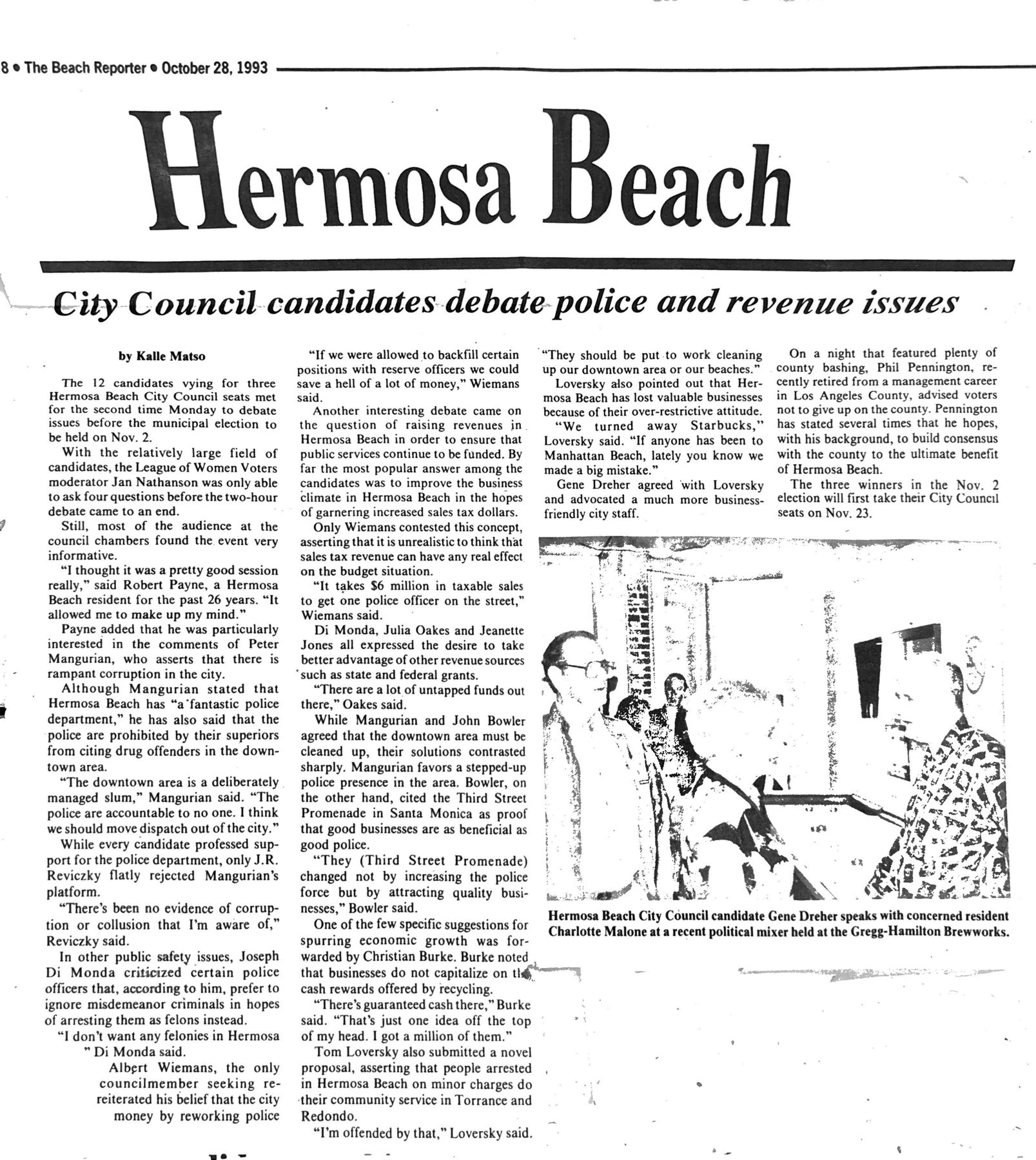
Hermosa Beach City Council candidate Gene Dreher speaks with concerned resident Charlotte Malone at a recent political mixer held at the Gregg-Hamilton Brewworks.
Show the original machine reading
Source scan page 34
8 ? The Beach Reporter ? October 28, 1993
Hermosa Beach
City Council candidates debate police and revenue issues
"They should be put to work cleaning
up our downtown area or our beaches."
Loversky also pointed out that Her-
mosa Beach has lost valuable businesses
because of their over-restrictive attitude.
"We turned awayStarbucks,"
Loversky said. "If anyone has been to
Manhattan Beach, lately you know we
made a big mistake."
Gene Dreher agreed with Loversky
and advocated a much more business-
friendly city staff.
On a night that featured plenty of
county bashing, Phil Pennington, re-
cently retired from a management career
in Los Angeles County, advised voters
not to give up on the county. Pennington
has stated several times that he hopes,
with his background, to build consensus
with the county to the ultimate benefit
of Hermosa Beach.
The three winners in the Nov.
election will first take their City Council
seats on Nov. 23.
by Kalle Matso
The 12 candidates vying for three
Hermosa Beach City Council seats met
for the second time Monday to debate
issues before the municipal election to
be held on Nov. 2.
With the relatively large field of
candidates, the League of Women Voters
moderator Jan Nathanson was only able
to ask four questions before the two-hour
debate came to an end
Still, most of the audience at the
council chambers found the event very
informative.
"I thought it was a pretty good session
really," said Robert Payne, a Hermosa
Beach resident for the past 26 years. "It
allowed me to make up my mind."
Payne added that he was particularly
interested in the comments of Peter
Mangurian, who assertsthat there is
rampant corruption in the city.
Although Mangurian stated that
Hermosa Beach has "a fantastic police
department," he has also said that the
police are prohibited by their superiors
from citing drug offenders in the down-
town area.
"The downtown area is a deliberately
managed slum," Mangurian said. "The
police are accountable to no one. I think
we should move dispatch out of the city."
While every candidate professed sup-
port for the police department, only J.R
Revicky flatly rejected Mangurian's
platform.
"There's been no evidence of corrup-
tion or collusion that I'm aware of,"
Revicky said
In other public safety issues, Joseph
Di Monda criticized certain police
officers that, according to him, prefer to
ignore misdemeanor criminals in hopes
of arresting them as felons instead.
"I don't want any felonies in Hermosa
Beach, " Di Monda said.
Mayor Albert Wiemans, the only
current councilmember seeking re-
election, reiterated his belief that the city
could save money by reworking police
salaries.
"If we were allowed to backfill certain
positions with reserve officers we could
save a hell of a lot of money," Wiemans
said
Another interesting debate came on
the question of raising revenues in
Hermosa Beach in order to ensure that
public services continue to be funded. By
far the most popular answer among the
candidates was to improve the business
climate in Hermosa Beach in the hopes
of garnering increased sales tax dollars.
Only Wiemans contested this concept,
asserting that it is unrealistic to think that
sales tax revenue can have any real effect
on the budget situation.
"It takes $6 million in taxable sales
to get one police officer on the street,"
Wiemans said.
Di Monda, Julia Oakes and Jeanette
Jones all expressed the desire to take
better advantage of other revenue sources
such as state and federal grants.
"There are a lot of untapped funds out
there," Oakes said.
While Mangurian and John Bowler
agreed that the downtown area must be
cleanedup, their solutions contrasted
sharply. Mangurian favors a stepped-up
police presence in the area. Bowler, on
the other hand, cited the Third Street
Promenade in Santa Monica as proof
that good businesses are as beneficial as
good police.
"They (Third Street Promenade)
changed not by increasing the police
force but by attracting quality busi
nesses," Bowler said.
One of the few specific suggestions for
spurring economic growth was for-
warded by Christian Burke. Burke noted
that businesses do not capitalize on the
cash rewards offered by recycling.
"There's guaranteed cash there," Burke
said. "That's just one idea off the top
of my head. I got a million of them."
Tom Loversky also submitted a novel
proposal, asserting that people arrested
in Hermosa Beach on minor charges do
their community service in Torrance and
Redondo.
"I'm offended by that," Loversky said.
Hermosa Beach City Council candidate Gene Dreher speaks with concerned resident
Charlotte Malone at a recent political mixer held at the Gregg-Hamilton Brewworks.