Letters and email · November 10, 2002
Shari Petresky advocates municipal library access options
Former librarian compares County and municipal access, borrowing fees and service arrangements following the October 22 hearing. Claims and forecasts are attributed to Petresky.
Text
Transcribed from the scans and checked against them by Claude. Typed text comes first; handwritten notes follow it. [illegible] marks words that cannot be read and [?] an uncertain reading.
Page 1
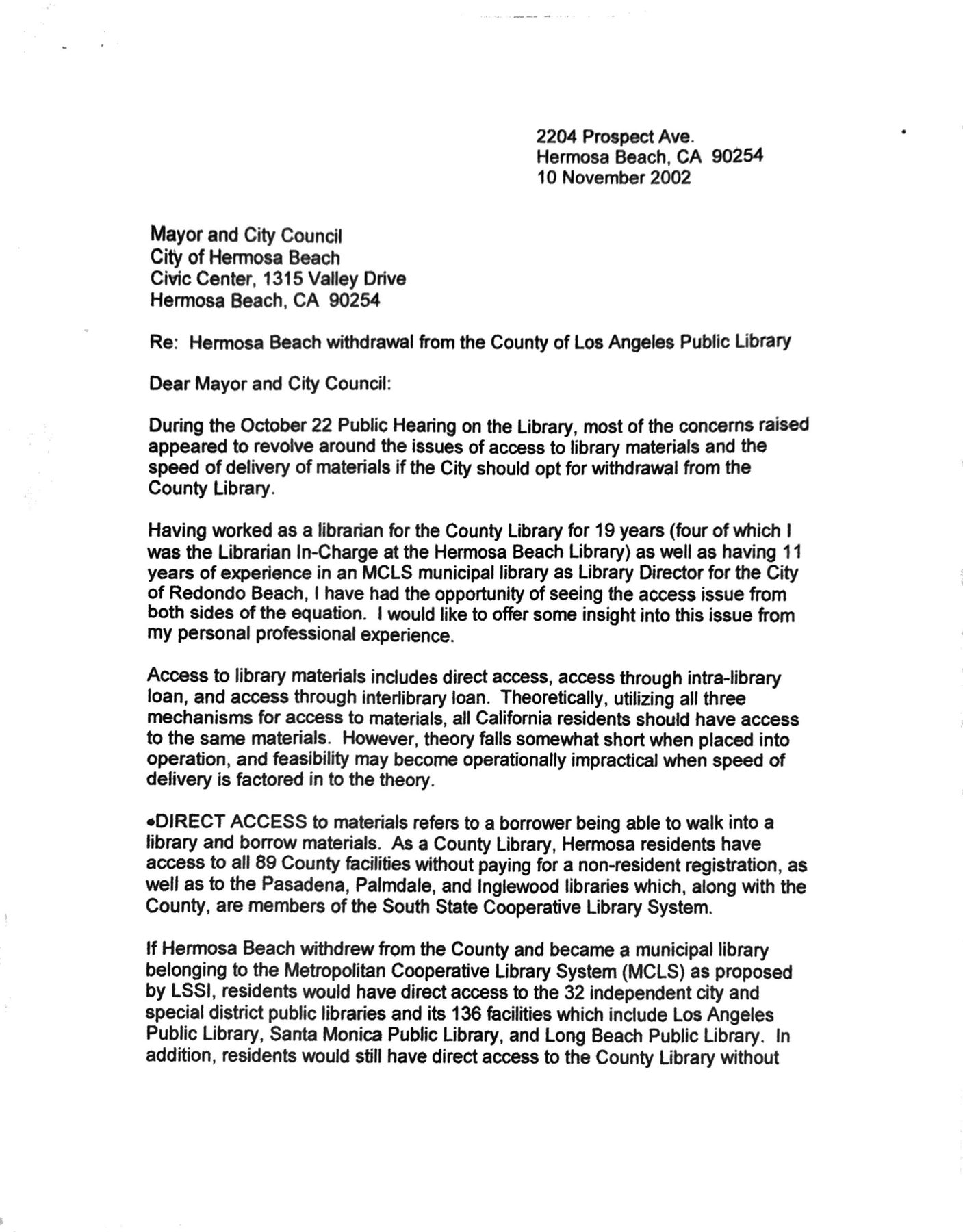
2204 Prospect Ave.
Hermosa Beach, CA 90254
10 November 2002
Mayor and City Council
City of Hermosa Beach
Civic Center, 1315 Valley Drive
Hermosa Beach, CA 90254
Re: Hermosa Beach withdrawal from the County of Los Angeles Public Library
Dear Mayor and City Council:
During the October 22 Public Hearing on the Library, most of the concerns raised appeared to revolve around the issues of access to library materials and the speed of delivery of materials if the City should opt for withdrawal from the County Library.
Having worked as a librarian for the County Library for 19 years (four of which I was the Librarian In-Charge at the Hermosa Beach Library) as well as having 11 years of experience in an MCLS municipal library as Library Director for the City of Redondo Beach, I have had the opportunity of seeing the access issue from both sides of the equation. I would like to offer some insight into this issue from my personal professional experience.
Access to library materials includes direct access, access through intra-library loan, and access through interlibrary loan. Theoretically, utilizing all three mechanisms for access to materials, all California residents should have access to the same materials. However, theory falls somewhat short when placed into operation, and feasibility may become operationally impractical when speed of delivery is factored in to the theory.
•DIRECT ACCESS to materials refers to a borrower being able to walk into a library and borrow materials. As a County Library, Hermosa residents have access to all 89 County facilities without paying for a non-resident registration, as well as to the Pasadena, Palmdale, and Inglewood libraries which, along with the County, are members of the South State Cooperative Library System.
If Hermosa Beach withdrew from the County and became a municipal library belonging to the Metropolitan Cooperative Library System (MCLS) as proposed by LSSI, residents would have direct access to the 32 independent city and special district public libraries and its 136 facilities which include Los Angeles Public Library, Santa Monica Public Library, and Long Beach Public Library. In addition, residents would still have direct access to the County Library without
Page 2
paying for non-resident registration. Direct access to materials would be more than doubled.
Currently Hermosa Beach residents do have direct access to some of the MCLS libraries, such as Redondo Beach (which has 6069 Hermosa Beach residents as borrowers), without paying for a non-resident registration, but increasingly MCLS libraries have begun instituting non-resident registration. As the County Library's budget for new materials has dwindled, MCLS libraries have had an explosion of non-resident use. The non-resident registration fees are designed to offset the cost of non-resident use as well as to discourage it. If the County's budget for library materials continues to decline, it is probable that more MCLS libraries will institute non-resident registration fees, further eroding Hermosa residents' free direct access to library materials. Some sample non-resident registration fees:
$138.10 Beverly Hills
$100 Cerritos
$60 Thousand Oaks
$50 Burbank
$40 El Segundo
$30 Pomona
In terms of direct access to library materials and collections without payment of non-resident registration fees, Hermosa Beach residents would have far greater access if they had a municipal library associated with MCLS than having a County library associated with South State.
•INTRALIBRARY LOAN refers to access to materials by means of borrowing them from another branch of the same library.
In the past, the County Library's materials budget was sufficient for most local libraries to purchase the new materials of interest to its residents and to utilize intralibrary loan borrowing from other branches with more space to house older and less frequently needed materials. This WAS an outstanding system, but as the County's budget dwindled, the local library was able to purchase fewer and fewer new materials. The other County facilities were in the same boat, resulting in an ever diminishing pool of new materials to borrow and longer waits as more borrowers competed for loans of fewer books.
In general, municipal libraries have fared better with materials budgets. Most municipal libraries have adequate funds to purchase the new materials desired by their residents, and even have the flexibility to run to the nearest book store and purchase a title, or additional copies of a title, if needed. Municipal libraries do not have to rely on intralibrary loan the way the County does.
LSSI's proposal of $35,000 a year for materials is far greater than the quoted current budget of $5000 given by the County to Hermosa Beach. If Hermosa
Page 3
was to withdraw from the County and contract with LSSI, there would be an excess of $100,000 a year which might be used to further supplement the Materials Budget or to purchase additional hours of service.
In terms of intralibrary loan access, Hermosa residents would have greater access to new materials as a municipal library without intralibrary loan.
•INTERLIBRARY LOAN ACCESS is used by libraries for access to materials which are specialized, of limited interest to its community, or out of print materials unavailable for purchase.
The County Library utilizes intralibrary loan to access older materials at no charge to its borrowers. Municipal libraries use interlibrary loan to access books from its member libraries at a charge set by the City Council. In Redondo, residents are not charged an interlibrary loan fee, although non-residents are charged a fee of $3.00. The County and MCLS have comparable delivery services making the speed of delivery very similar.
For specialized or out of print materials only available from an academic, special, or out of area library, both the County and municipal libraries utilize interlibrary loan. They access materials nationwide through OCLC, a national bibliographic utility widely used for interlibrary loan. The County charges an interlibrary loan fee of $3.00 to both its residents and non-residents. The delivery time for an interlibrary loan with the County is so long as to be impractical in most cases, probably due to the time expended as the request makes its way from local library to regional library to library headquarters.
Municipal libraries generally receive interlibrary loans from out of the area within two to four weeks. This delivery speed discrepancy may account for the number of Hermosa Beach residents traveling to Redondo to place interlibrary loan requests. The increasing number of County borrowers using their interlibrary loan service is the reason that Redondo increased its interlibrary loan fee to the same amount as the County fee, to offset the cost of non-resident use and to discourage it.
In terms of interlibrary loan access to specialized or locally unavailable materials, Hermosa Beach residents would have both greater access and speedier access as a municipal library than as a County Library.
IN SUMMARY, if Hermosa Beach was to withdraw from the County and become an MCLS associated municipal library, the residents would have both increased access to materials, and increased speed of delivery of materials. That 6069 Hermosa Beach residents are borrowers at the Redondo Beach Library attest to the inadequacy of access to materials with the County Library. People will
Page 4
generally not travel an extra inch for something they can obtain locally. It is evident that the County Library is not adequately meeting the needs of Hermosa residents.
Additionally, as a municipal library Hermosa Beach would have increased control over library operations, a guaranteed stable funding level within its portion of library tax, increased opportunities for fundraising, an opportunity to improve some service levels, and the ability to join MCLS or other cooperative organizations.
Sincerely,
Shari L. Petresky
c: Steve Burrell, City Manager
Show the original machine reading
Source scan page 65
2204 Prospect Ave.
Hermosa Beach, CA 90254
10 November 2002
Mayor and City Council
City of Hermosa Beach
Civic Center, 1315 Valley Drive
Hermosa Beach, CA 90254
Re: Hermosa Beach withdrawal from the County of Los Angeles Public Library
Dear Mayor and City Council:
During the October 22 Public Hearing on the Library, most of the concerns raised
appeared to revolve around the issues of access to library materials and the
speed of delivery of materials if the City should opt for withdrawal from the County Library.
Having worked as a librarian for the County Library for 19 years (four of which I
was the Librarian In-Charge at the Hermosa Beach Library) as well as having 11
years of experience in an MCLS municipal library as Library Director for the City
of Redondo Beach, I have had the opportunity of seeing the access issue from
both sides of the equation. I would like to offer some insight into this issue from
my personal professional experience.
Access to library materials includes direct access, access through intra-library
loan, and access through interlibrary loan. Theoretically, utilizing all three
mechanisms for access to materials, all California residents should have access
to the same materials. However, theory falls somewhat short when placed into
operation, and feasibility may become operationally impractical when speed of
delivery is factored in to the theory.
?DIRECT ACCESS to materials refers to a borrower being able to walk into a
library and borrow materials. As a County Library, Hermosa residents have
access to all 89 County facilities without paying for a non-resident registration, as
well as to the Pasadena, Palmdale, and Inglewood libraries which, along with the
County, are members of the South State Cooperative Library System.
If Hermosa Beach withdrew from the County and became a municipal library
belonging to the Metropolitan Cooperative Library System (MCLS) as proposed
by LSSI, residents would have direct access to the 32 independent city and
special district public libraries and its 136 facilities which include Los Angeles
Public Library, Santa Monica Public Library, and Long Beach Public Library. In
addition, residents would still have direct access to the County Library without
Source scan page 66
paying for non-resident registration. Direct access to materials would be more than doubled.
Currently Hermosa Beach residents do have direct access to some of the MCLS
libraries, such as Redondo Beach (which has 6069 Hermosa Beach residents as
borrowers), without paying for a non-resident registration, but increasingly MCLS
libraries have begun instituting non-resident registration. As the County Library's
budget for new materials has dwindled, MCLS libraries have had an explosion of
non-resident use. The non-resident registration fees are designed to offset the
cost of non-resident use as well as to discourage it. If the County's budget for
library materials continues to decline, it is probable that more MCLS libraries will
institute non-resident registration fees, further eroding Hermosa residents' free
direct access to library materials. Some sample non-resident registration fees: $138.10 Beverly Hills $100 Cerritos
$60 Thousand Oaks
$50 Burbank
$40 El Segundo $30 Pomona
In terms of direct access to library materials and collections without payment of
non-resident registration fees, Hermosa Beach residents would have far greater
access if they had a municipal library associated with MCLS than having a County library associated with South State.
?INTRALIBRARY LOAN refers to access to materials by means of borrowing
them from another branch of the same library.
In the past, the County Library's materials budget was sufficient for most local
libraries to purchase the new materials of interest to its residents and to utilize
intralibrary loan borrowing from other branches with more space to house older
and less frequently needed materials. This WAS an outstanding system, but as
the County's budget dwindled, the local library was able to purchase fewer and
fewer new materials. The other County facilities were in the same boat, resulting
in an ever diminishing pool of new materials to borrow and longer waits as more borrowers competed for loans of fewer books.
In general, municipal libraries have fared better with materials budgets. Most
municipal libraries have adequate funds to purchase the new materials desired
by their residents, and even have the flexibility to run to the nearest book store
and purchase a title, or additional copies of a title, if needed. Municipal libraries
do not have to rely on intralibrary loan the way the County does.
LSSI's proposal of $35,000 a year for materials is far greater than the quoted
current budget of $5000 given by the County to Hermosa Beach. If Hermosa
Source scan page 67
was to withdraw from the County and contract with LSSI, there would be an
excess of $100,000 a year which might be used to further supplement the
Materials Budget or to purchase additional hours of service.
In terms of intralibrary loan access, Hermosa residents would have greater
access to new materials as a municipal library without intralibrary loan.
?INTERLIBRARY LOAN ACCESS is used by libraries for access to materials
which are specialized, of limited interest to its community, or out of print materials unavailable for purchase.
The County Library utilizes intralibrary loan to access older materials at no
charge to its borrowers. Municipal libraries use interlibrary loan to access books
from its member libraries at a charge set by the City Council. In Redondo,
residents are not charged an interlibrary loan fee, although non-residents are
charged a fee of $3.00. The County and MCLS have comparable delivery
services making the speed of delivery very similar.
For specialized or out of print materials only available from an academic, special,
or out of area library, both the County and municipal libraries utilize interlibrary
loan. They access materials nationwide through OCLC, a national bibliographic
utility widely used for interlibrary loan. The County charges an interlibrary loan
fee of $3.00 to both its residents and non-residents. The delivery time for an
interlibrary loan with the County is so long as to be impractical in most cases,
probably due to the time expended as the request makes its way from local
library to regional library to library headquarters.
Municipal libraries generally receive interlibrary loans from out of the area within
two to four weeks. This delivery speed discrepancy may account for the number
of Hermosa Beach residents traveling to Redondo to place interlibrary loan
requests. The increasing number of County borrowers using their interlibrary
loan service is the reason that Redondo increased its interlibrary loan fee to the
same amount as the County fee, to offset the cost of non-resident use and to
discourage it.
In terms of interlibrary loan access to specialized or locally unavailable materials,
Hermosa Beach residents would have both greater access and speedier access
as a municipal library than as a County Library.
IN SUMMARY, if Hermosa Beach was to withdraw from the County and become
an MCLS associated municipal library, the residents would have both increased
access to materials, and increased speed of delivery of materials. That 6069
Hermosa Beach residents are borrowers at the Redondo Beach Library attest to
the inadequacy of access to materials with the County Library. People will
Source scan page 68
generally not travel an extra inch for something they can obtain locally. It is
evident that the County Library is not adequately meeting the needs of Hermosa residents.
Additionally, as a municipal library Hermosa Beach would have increased control
over library operations, a guaranteed stable funding level within its portion of
library tax, increased opportunities for fundraising, an opportunity to improve
some service levels, and the ability to join MCLS or other cooperative organizations.
Sincerely,
Shari L. Petresky
c: Steve Burrell, City Manager