Reports and proposals · November 21, 2002
City staff outlines County withdrawal options for November 26
Four-page report responds to the October hearing, discusses collections and startup costs, and presents options to remain, withdraw effective July 2003, or investigate further. The report does not record a final decision.
Text
Transcribed from the scans and checked against them by Claude. Typed text comes first; handwritten notes follow it. [illegible] marks words that cannot be read and [?] an uncertain reading.
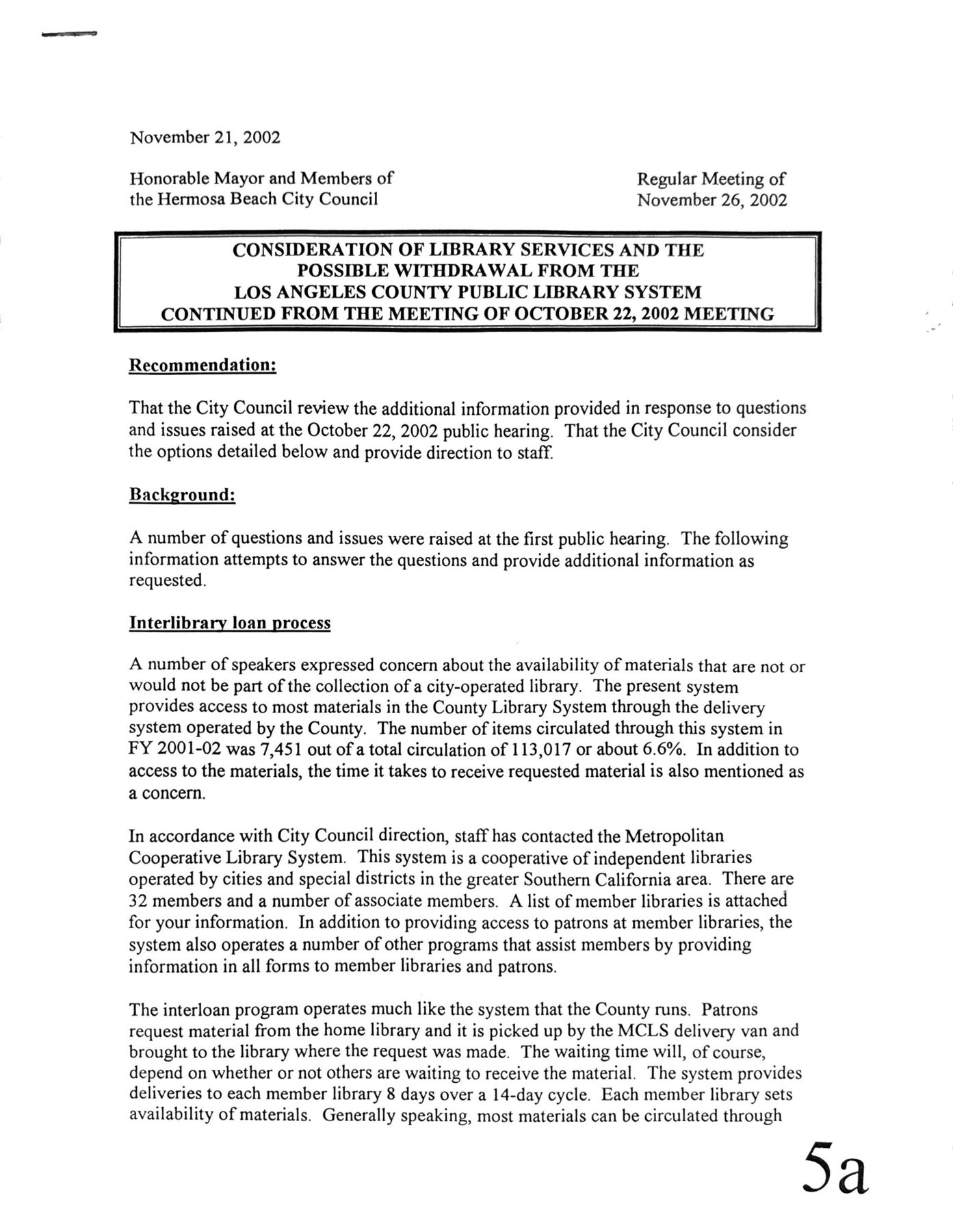
Page 1
November 21, 2002
Honorable Mayor and Members of the Hermosa Beach City Council
Regular Meeting of November 26, 2002
CONSIDERATION OF LIBRARY SERVICES AND THE POSSIBLE WITHDRAWAL FROM THE LOS ANGELES COUNTY PUBLIC LIBRARY SYSTEM CONTINUED FROM THE MEETING OF OCTOBER 22, 2002 MEETING
Recommendation:
That the City Council review the additional information provided in response to questions and issues raised at the October 22, 2002 public hearing. That the City Council consider the options detailed below and provide direction to staff.
Background:
A number of questions and issues were raised at the first public hearing. The following information attempts to answer the questions and provide additional information as requested.
Interlibrary loan process
A number of speakers expressed concern about the availability of materials that are not or would not be part of the collection of a city-operated library. The present system provides access to most materials in the County Library System through the delivery system operated by the County. The number of items circulated through this system in FY 2001-02 was 7,451 out of a total circulation of 113,017 or about 6.6%. In addition to access to the materials, the time it takes to receive requested material is also mentioned as a concern.
In accordance with City Council direction, staff has contacted the Metropolitan Cooperative Library System. This system is a cooperative of independent libraries operated by cities and special districts in the greater Southern California area. There are 32 members and a number of associate members. A list of member libraries is attached for your information. In addition to providing access to patrons at member libraries, the system also operates a number of other programs that assist members by providing information in all forms to member libraries and patrons.
The interloan program operates much like the system that the County runs. Patrons request material from the home library and it is picked up by the MCLS delivery van and brought to the library where the request was made. The waiting time will, of course, depend on whether or not others are waiting to receive the material. The system provides deliveries to each member library 8 days over a 14-day cycle. Each member library sets availability of materials. Generally speaking, most materials can be circulated through
5a
Page 2
this system. In some cases, there are special collections that do not leave the home library and the patron would have to go to the library to use the material. The cost for this service is part of the membership fee that each library pays to be part of the system. The state provides some funding for this program, as it does for other services operated by the MCLS. There is no charge for the patron unless the member library wishes to charge the patron for making the request. The question of whether or not there is a charge is a local decision.
As an aside, it appears that most library operations are members or associate members of cooperative borrowing programs. These programs are encouraged and sometimes funded by the state and others to increase the availability of materials to those that are interested in using them. In addition to MLCS, there is the Santiago Library System, which serves Orange County, and the South State Cooperative System, which includes the LA County Public Library, Pasadena, Palmdale, and Inglewood. The Santiago Library System is operated jointly with MLCS.
Materials Budget
The materials budget for the library was a concern expressed at the public hearing. The proposal that the committee developed included a budget of $35,000 per year. This was a target and based on what the county has been able to spend over the last several years, which has averaged about $25,000 per year. Based on the information provided by the county, this works out to about $7.00 per item added to the collection each year. This seems low for purchase of books which we have been told would run around $20.00 per book. The decline of spending of funds in the materials category has been one of the concerns of the Library Subcommittee. The decline of spending has been the result of tighter funding provided to the County System over the last several years. It was reported that the current year materials budget was cut in order to keep all of the branch libraries open. I do not think that the county can be faulted for making this decision as access to the library system is largely determined by the hours it is open to the public. It does however, show that overall the system does not have the funds that it needs to update the collection. It should also be noted that the collection of a library is always changing and being updated so it is important to have a budget that will be able to reflect the needs of the community. The target budget included in the proposal was a beginning point and could be adjusted within the funding framework of the revenue available.
Collection - Purchase new one or buy the existing collection?
The process of withdrawing includes an opportunity to purchase all or part of the existing collection. The cost of this is not known, as the negotiations with the county have not taken place. There are a number of special collections housed in the library that would remain based on the conditions of the gifts by the Friends of Library as well as others over the years. The cost of the opening date collection, whether purchased from the county or a vendor, could range from $250,000 to $400,000 depending on the size. This cost can be financed (either internally or externally) over a period of 5 to 6 years and paid from the funding that would be received from property tax revenue. However, it would
Page 3
appear that spreading the cost over a period of time would be a reasonable way to proceed. The difficulty of developing a cost for the collection stems from the value that the county would place on the existing collection or the size of the new collection purchased. The county valued the Calabasas collection at replacement value and the city opted to purchase a new collection at a cost of around $250,000. Calabasas has added to the collection each year and presently is spending $60,000 for new purchases. Calabasas has a collection of 23,000 volumes and the circulation numbers are comparable with ours. They have fewer interlibrary loans than we have. This could be the result of having a collection that reflects the present needs of the community. Most new libraries build the collection over a period time, adding to the opening date collection to meet the needs of the patrons served. This approach would provide an opportunity for community groups to assist providing additional funding for the library in order to add to the materials budget as the Friends of the Library does now.
Funding
The funding situation, because the state is in financial distress, was also a concern expressed at the last meeting. Unlike the other issues addressed here, staff really cannot provide an answer. It will most likely be months before a solution is crafted and the impact, if any, known. In this case, the best approach may be to look at the actions taken by the state in the past. The biggest impact on local funding was when the property tax was shifted to the state and used to fund state responsibilities. When these funds were taken from cities, counties, and special districts, services provided were cut back. This is when the library hours were reduced. If the state were to take a similar action this year property tax funds paid by local property owners would be used to pay for state operations. This would affect both the city and the special library funds. If special district property taxes were left alone, funding for the library, whether as a part of the LA County system or as a city operation, would not be effected. The library funds can only be used for library purposes. There is really no way of knowing what the state may do in order to close the $21 billion gap that has been reported. It is possible that the City will be facing a whole array of issues if property taxes are taken from local government.
Options
The following options are available for the City Council in considering this issue:
1. Accept the report and remain with the Los Angeles County Public Library System. No action need be taken.
2. Direct staff to draft a letter for the Mayor's signature informing the Los Angeles County Public Library System that the City of Hermosa Beach intends to withdraw from the system and operate a city library effective 7/1/03. If this option is chosen, staff would need to be directed to begin negotiations with the county concerning the withdrawal and to draft ordinances to set up the city library operation.
Page 4
3. Direct staff to do further research and study and report back at a future meeting on any issues or provide more detail on the several aspects of the proposal to operate a city library. This would mean that the first opportunity to begin a city operated library would be 7/1/04.
Respectfully submitted,
Stephen R. Burrell
City Manager
Handwritten notes
• (signature) Stephen R. Burrell
Show the original machine reading
Source scan page 71
November 21, 2002
Honorable Mayor and Members of
the Hermosa Beach City Council
Regular Meeting of
November 26, 2002
CONSIDERATION OF LIBRARY SERVICES AND THE
POSSIBLE WITHDRAWAL FROM THE
LOS ANGELES COUNTY PUBLIC LIBRARY SYSTEM
CONTINUED FROM THE MEETING OF OCTOBER 22, 2002 MEETING
Recommendation:
That the City Council review the additional information provided in response to questions
and issues raised at the October 22, 2002 public hearing. That the City Council consider
the options detailed below and provide direction to staff.
Background:
A number of questions and issues were raised at the first public hearing. The following
information attempts to answer the questions and provide additional information as
requested
Interlibrary loan process
A number of speakers expressed concern about the availability of materials that are not or
would not be part of the collection of a city-operated library. The present system
provides access to most materials in the County Library System through the delivery
system operated by the County. The number of items circulated through this system in
FY 2001-02 was 7,451 out of a total circulation of 113,017 or about 6.6%. In addition to
access to the materials, the time it takes to receive requested material is also mentioned as
a concern.
In accordance with City Council direction, staff has contacted the Metropolitan
Cooperative Library System. This system is a cooperative of independent libraries
operated by cities and special districts in the greater Southern California area. There are
32 members and a number of associate members. A list of member libraries is attached
for your information. In addition to providing access to patrons at member libraries, the
system also operates a number of other programs that assist members by providing
information in all forms to member libraries and patrons.
The interloan program operates much like the system that the County runs. Patrons
request material from the home library and it is picked up by the MCLS delivery van and
brought to the library where the request was made. The waiting time will, of course,
depend on whether or not others are waiting to receive the material. The system provides
deliveries to each member library 8 days over a 14-day cycle. Each member library sets
availability of materials. Generally speaking, most materials can be circulated through
Sa
Source scan page 72
this system. In some cases, there are special collections that do not leave the home
library and the patron would have to go to the library to use the material. The cost for
this service is part of the membership fee that each library pays to be part of the system.
The state provides some funding for this program, as it does for other services operated
by the MCLS. There is no charge for the patron unless the member library wishes to
charge the patron for making the request. The question of whether or not there is a
charge is a local decision.
As an aside, it appears that most library operations are members or associate members of
cooperative borrowing programs. These programs are encouraged and sometimes funded
by the state and others to increase the availability of materials to those that are interested
in using them. In addition to MCS, there is the Santiago Library System, which serves
Orange County, and the South State Cooperative System, which includes the LA County
Public Library, Pasadena, Palmdale, and Inglewood. The Santiago Library System is
operated jointly with MLCS.
Materials Budget
The materials budget for the library was a concern expressed at the public hearing. The
proposal that the committee developed included a budget of $35,000 per year. This was a
target and based on what the county has been able to spend over the last several years,
which has averaged about $25,000 per year. Based on the information provided by the
county, this works out to about $7.00 per item added to the collection each year. This
seems low for purchase of books which we have been told would run around $20.00 per
book. The decline of spending of funds in the materials category has been one of the
concerns of the Library Subcommittee. The decline of spending has been the result of
tighter funding provided to the County System over the last several years. It was reported
that the current year materials budget was cut in order to keep all of the branch libraries
open. I do not think that the county can be faulted for making this decision as access to
the library system is largely determined by the hours it is open to the public. It does
however, show that overall the system does not have the funds that it needs to update the
collection. It should also be noted that the collection of a library is always changing and
being updated so it is important to have a budget that will be able to reflect the needs of
the community. The target budget included in the proposal was a beginning point and
could be adjusted within the funding framework of the revenue available.
Collection - Purchase new one or buy the existing collection?
The process of withdrawing includes an opportunity to purchase all or part of the existing
collection. The cost of this is not known, as the negotiations with the county have not
taken place. There are a number of special collections housed in the library that would
remain based on the conditions of the gifts by the Friends of Library as well as others
over the years. The cost of the opening date collection, whether purchased from the
county or a vendor, could range from $250,000 to $400,000 depending on the size. This
cost can be financed (either internally or externally) over a period of 5 to 6 years and paid
from the funding that would be received from property tax revenue. However, it would
Source scan page 73
appear that spreading the cost over a period of time would be a reasonable way to
proceed. The difficulty of developing a cost for the collection stems from the value that
the county would place on the existing collection or the size of the new collection
purchased. The county valued the Calabasas collection at replacement value and the city
opted to purchase a new collection at a cost of around $250,000. Calabasas has added to
the collection each year and presently is spending $60,000 for new purchases. Calabasas
has a collection of 23,000 volumes and the circulation numbers are comparable with ours.
They have fewer interlibrary loans than we have. This could be the result of having a
collection that reflects the present needs of the community. Most new libraries build the
collection over a period time, adding to the opening date collection to meet the needs of
the patrons served. This approach would provide an opportunity for community groups
to assist providing additional funding for the library in order to add to the materials
budget as the Friends of the Library does now.
Funding
The funding situation, because the state is in financial distress, was also a concern
expressed at the last meeting. Unlike the other issues addressed here, staff really cannot
provide an answer. It will most likely be months before a solution is crafted and the
impact, if any, known. In this case, the best approach may be to look at the actions taken
by the state in the past. The biggest impact on local funding was when the property tax
was shifted to the state and used to fund state responsibilities. When these funds were
taken from cities, counties, and special districts, services provided were cut back. This is
when the library hours were reduced. If the state were to take a similar action this year
property tax funds paid by local property owners would be used to pay for state
operations. This would affect both the city and the special library funds. If special
district property taxes were left alone, funding for the library, whether as a part of the LA
County system or as a city operation, would not be effected. The library funds can only
be used for library purposes. There is really no way of knowing what the state may do in
order to close the $21 billion gap that has been reported. It is possible that the City will
be facing a whole array of issues if property taxes are taken from local government.
Options
The following options are available for the City Council in considering this issue:
1. Accept the report and remain with the Los Angeles County Public Library
System. No action need be taken.
2. Direct staff to draft a letter for the Mayor's signature informing the Los Angeles
County Public Library System that the City of Hermosa Beach intends to
withdraw from the system and operate a city library effective 7/1/03. If this
option is chosen, staff would need to be directed to begin negotiations with the
county concerning the withdrawal and to draft ordinances to set up the city library
operation.
Source scan page 74
3. Direct staff to do further research and study and report back at a future meeting on
any issues or provide more detail on the several aspects of the proposal to operate
a city library. This would mean that the first opportunity to begin a city operated
library would be 7/1/04.
Respectfully submitted,
Stephen R. Burrell
City Manager