Newspaper clippings · January 12, 1989
The Beach Reporter — The write stuff
Michael Hamer feature on December 1988 authors' boutique and local writers; profiles Michael Andrews, Sheila Finch and Jake Luis Varela.
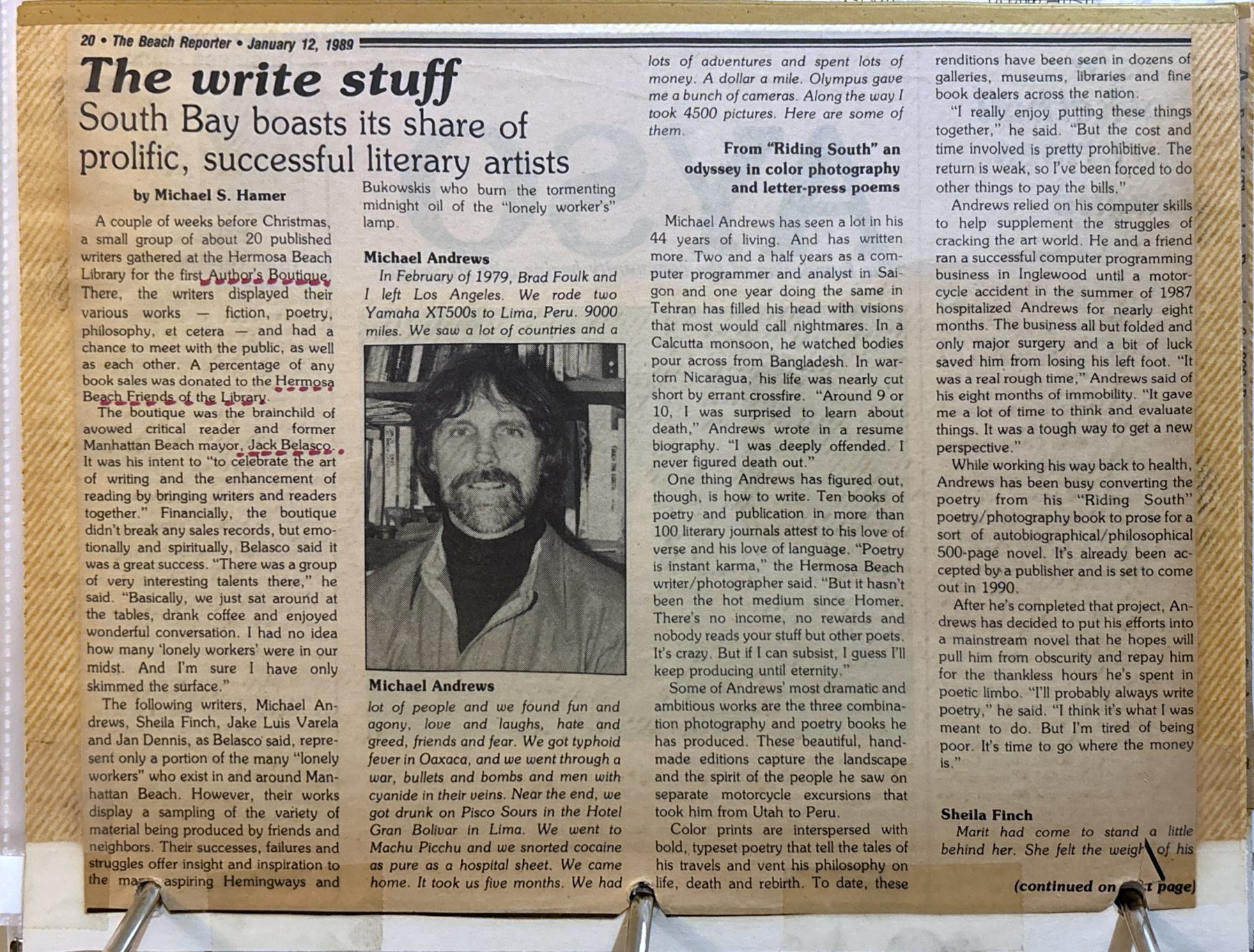
Text
Transcribed from the scans and checked against them by Claude. Typed text comes first; handwritten notes follow it. [illegible] marks words that cannot be read and [?] an uncertain reading.
Page 1
20 • The Beach Reporter • January 12, 1989
The write stuff
South Bay boasts its share of prolific, successful literary artists
by Michael S. Hamer
A couple of weeks before Christmas, a small group of about 20 published writers gathered at the Hermosa Beach Library for the first Author's Boutique. There, the writers displayed their various works — fiction, poetry, philosophy, et cetera — and had a chance to meet with the public, as well as each other. A percentage of any book sales was donated to the Hermosa Beach Friends of the Library.
The boutique was the brainchild of avowed critical reader and former Manhattan Beach mayor, Jack Belasco. It was his intent to "to celebrate the art of writing and the enhancement of reading by bringing writers and readers together." Financially, the boutique didn't break any sales records, but emotionally and spiritually, Belasco said it was a great success. "There was a group of very interesting talents there," he said. "Basically, we just sat around at the tables, drank coffee and enjoyed wonderful conversation. I had no idea how many 'lonely workers' were in our midst. And I'm sure I have only skimmed the surface."
The following writers, Michael Andrews, Sheila Finch, Jake Luis Varela and Jan Dennis, as Belasco said, represent only a portion of the many "lonely workers" who exist in and around Manhattan Beach. However, their works display a sampling of the variety of material being produced by friends and neighbors. Their successes, failures and struggles offer insight and inspiration to the many aspiring Hemingways and Bukowskis who burn the tormenting midnight oil of the "lonely worker's" lamp.
Michael Andrews
In February of 1979, Brad Foulk and I left Los Angeles. We rode two Yamaha XT500s to Lima, Peru. 9000 miles. We saw a lot of countries and a lot of people and we found fun and agony, love and laughs, hate and greed, friends and fear. We got typhoid fever in Oaxaca, and we went through a war, bullets and bombs and men with cyanide in their veins. Near the end, we got drunk on Pisco Sours in the Hotel Gran Bolivar in Lima. We went to Machu Picchu and we snorted cocaine as pure as a hospital sheet. We came home. It took us five months. We had lots of adventures and spent lots of money. A dollar a mile. Olympus gave me a bunch of cameras. Along the way I took 4500 pictures. Here are some of them.
From "Riding South" an odyssey in color photography and letter-press poems
Michael Andrews
Michael Andrews has seen a lot in his 44 years of living. And has written more. Two and a half years as a computer programmer and analyst in Saigon and one year doing the same in Tehran has filled his head with visions that most would call nightmares. In a Calcutta monsoon, he watched bodies pour across from Bangladesh. In war-torn Nicaragua, his life was nearly cut short by errant crossfire. "Around 9 or 10, I was surprised to learn about death," Andrews wrote in a resume biography. "I was deeply offended. I never figured death out."
One thing Andrews has figured out, though, is how to write. Ten books of poetry and publication in more than 100 literary journals attest to his love of verse and his love of language. "Poetry is instant karma," the Hermosa Beach writer/photographer said. "But it hasn't been the hot medium since Homer. There's no income, no rewards and nobody reads your stuff but other poets. It's crazy. But if I can subsist, I guess I'll keep producing until eternity."
Some of Andrews' most dramatic and ambitious works are the three combination photography and poetry books he has produced. These beautiful, hand-made editions capture the landscape and the spirit of the people he saw on separate motorcycle excursions that took him from Utah to Peru.
Color prints are interspersed with bold, typeset poetry that tell the tales of his travels and vent his philosophy on life, death and rebirth. To date, these renditions have been seen in dozens of galleries, museums, libraries and fine book dealers across the nation.
"I really enjoy putting these things together," he said. "But the cost and time involved is pretty prohibitive. The return is weak, so I've been forced to do other things to pay the bills."
Andrews relied on his computer skills to help supplement the struggles of cracking the art world. He and a friend ran a successful computer programming business in Inglewood until a motorcycle accident in the summer of 1987 hospitalized Andrews for nearly eight months. The business all but folded and only major surgery and a bit of luck saved him from losing his left foot. "It was a real rough time," Andrews said of his eight months of immobility. "It gave me a lot of time to think and evaluate things. It was a tough way to get a new perspective."
While working his way back to health, Andrews has been busy converting the poetry from his "Riding South" poetry/photography book to prose for a sort of autobiographical/philosophical 500-page novel. It's already been accepted by a publisher and is set to come out in 1990.
After he's completed that project, Andrews has decided to put his efforts into a mainstream novel that he hopes will pull him from obscurity and repay him for the thankless hours he's spent in poetic limbo. "I'll probably always write poetry," he said. "I think it's what I was meant to do. But I'm tired of being poor. It's time to go where the money is."
Sheila Finch
Marit had come to stand a little behind her. She felt the weight of his
(continued on next page)
Page 2
(continued from previous page)
presence before she saw him.
"LangSpec Kennedy," he said quietly. "Let Aleealee do the work. You're making it too difficult for yourself. He understands better than you how to do it."
Something gathered under the tree roots, like an electrical field that held the three of them in its charge. She glanced
Sheila Finch
from the alien to the man, and was instantly caught, as if eye contact had completed a circuit allowing energy to flow from one to the other to the next. Aleealee took her hand. A shockwave ran up her arm. With his other hand, he pulled Marit closer. She felt the ground slip. Then Marit took her free hand.
The world exploded. Unrecognizable shapes vanished into infinity.
There were no meanings — no concepts or ideas — only Knowing. Boundaries of self and other dissolved. The gates flew open . . .
From "Triad"
"Writing isn't always easy and it's especially difficult when you're being constantly rejected," Finch said. "But it has to be a form of play. It has to be something that you're compelled to do. If I didn't write, I think I'd have a breakdown."
A native of England, Finch came to the United States in the late 1950s and to California in 1962. She flirted with writing while in graduate school at Indiana University but put that career on hold because of the responsibilities of motherhood and a career. Fourteen years ago, she decided to try her hand again and had moderate success in selling mainstream short stories to several publications. Then, as suddenly as her work had been accepted, it was being rejected.
"The same editors who were regularly publishing my work started rejecting me," she said. "They kept saying that they didn't publish science fiction. I had no idea what they were talking about. I had never even read a science fiction novel."
Finch was baffled by her unintentional and unnamed genre until a 12-year-old boy gave her a copy of Ray Bradbury's "The Illustrated Man." "I brought it home and read it in one night," she said. "And I realized that that's what I was trying to do. I was trying to present today's concerns at a different angle. A sort of skewed reality."
With her literary niche discovered, Finch was off and writing. Today, aside from her growing success as a writer, she teaches, among other classes at ECC, a science-fiction as literature course. The class, she says, helps keep her in contact with new writers and has helped her cultivate new ideas. "Science-fiction is a very important literary genre," she said. "It's much easier to see the problems of today if you put them in the telescope of tomorrow."
Jake Luis Varela
Airspace, South Vietnam, December, 1967. The plane suddenly began its descent toward the Danang Airstrip half-lit below, darker than the horizon fading away in the distance. Engines backfired. Moments from now its flight and function would temporarily end. With luck, in the dawn of a new tomorrow, its engine would start anew, its cargo heavy with the lucky, jubilant soldiers leaving Vietnam for good, their minds ladened with unforgettable war stories, fear and a renewed thirst for life. Thirteen months of infamous fighting carving paths through the unknown and deadly jungles, and growing up quickly would follow them home to an unwelcoming, divided throng of Americans.
Opening paragraph of "No Sun In My Palace"
The Beach Reporter • January 12, 1989 • 21
The completion of Jake Luis Varela's Vietnam novel, "No Sun In My Palace," marked the end of a 12-year struggle to overcome the gruesome atrocities of a three-year Vietnam tour. Lost lives, lost friends, lost innocence. The whole Vietnam cliche was a haunting reality for an 18-year-old journalism student from New Mexico. It took its toll.
"I really had difficulty coping with what took place over there," said Varela
Jake Luis Varela
who toured with the Marines from 1967-69. "There were so many things that I didn't want to remember, but
(continued on next page)
Show the original machine reading
Source scan page 1
20 ? The Beach Reporter ? January 12, 1989
The write stuff
South Bay boasts its share of
prolific, successful literary artists
by Michael S. Hamer Bukowskis who burn the tormenting
midnight oil of the "lonely worker's"
A couple of weeks before Christmas, lamp
a small group of about 20 published
writers gathered at the Hermosa Beach
Library for the first Author's Boutique,
There, the writers displayedtheir
various works - fiction, poetry,
philosophy, et cetera - and had a
Michael Andrews
In February of 1979, Brad Foulk and
I left Los Angeles. We rode two
Yamaha XT500s to Lima, Peru. 9000
miles. We saw a lot of countries and a
chance to meet with the public, as well
as each other. A percentage of any
book sales was donated to the Hermosa
Beach Friends of the Library.
The boutique was the brainchild of
avowed critical reader and former
Manhattan Beach mayor, Jack Belasco.. It was his intent to "to celebrate the art
of writing and the enhancement of
reading by bringing writers and readers
together." Financially, the boutique
didn't break any sales records, but emo-
tionally and spiritually, Belasco said it
was a great success. "There was a group
of very interesting talents there," he
said. "Basically, we just sat around at
the tables, drank coffee and enjoyed
wonderful conversation. I had no idea
how many "lonely workers' were in our
midst.And I'm sure I have only
skimmed the surface."
Michael Andrews
The following writers, Michael An-
drews, Sheila Finch, Jake Luis Varela
and Jan Dennis, as Belasco said, repre-
sent only a portion of the many "lonely
workers" who exist in and around Man-
hattan Beach. However, their works
display a sampling of the variety of
material being produced by friends and
neighbors. Their successes, failures and
struggles offer insight and inspiration to
the may aspiring Hemingways and
lot of people and we found fun and
agony, love and laughs, hate and
greed, friends and fear. We got typhoid
fever in Oaxaca, and we went through a
war, bullets and bombs and men with
cyanide in their veins. Near the end, we
got drunk on Pisco Sours in the Hotel
Gran Bolivar in Lima. We went to
Machu Picchu and we snorted cocaine
as pure as a hospital sheet. We came
home. It took us five months. We had
lots of adventures and spent lots of
money. A dollar a mile. Olympus gave
me a bunch of cameras. Along the way I
took 4500 pictures. Here are some of
them
From "Riding South" an
odyssey in color photography
and letter-press poems
Michael Andrews has seen a lot in his
44 years of living. And has written
more. Two and a half years as a com-
puter programmer and analyst in Sai-
gon and one year doing the same in
Tehran has filled his head with visions
that most would call nightmares. In a
Calcutta monsoon, he watched bodies
pour across from Bangladesh. In war-
torn Nicaragua, his life was nearly cut
short by errant crossfire. "Around 9 or
10, I was surprised to learn about
death," Andrews wrote in a resume
biography. "I was deeply offended. I
never figured death out."
One thing Andrews has figured out,
though, is how to write. Ten books of
poetry and publication in more than
100 literary journals attest to his love of
verse and his love of language. "Poetry
is instant karma," the Hermosa Beach
writer/photographer said. "But it hasn't
been the hot medium since Homer.
There's no income,no rewards and
nobody reads your stuff but other poets.
It's crazy. But if I can subsist, I guess I'll
keep producing until eternity."
Some of Andrews' most dramatic and
ambitious works are the three combina-
and the spirit of the people he saw on
separate motorcycle excursions that
took him from Utah to Peru.
Color prints are interspersed with
bold, typeset poetry that tell the tales of
his travels and vent his philosophy on
life, death and rebirth. To date, these
renditions have been seen in dozens of
galleries, museums, libraries and fine
book dealers across the nation.
"I really enjoy putting these things
together, " he said. "But the cost and
time involved is pretty prohibitive. The
return is weak, so I've been forced to do
other things to pay the bills."
Andrews relied on his computer skills
to help supplement the struggles of
cracking the art world. He and a friend
ran a successful computer programming
business in Inglewood until a motor-
cycle accident in the summer of 1987
hospitalized Andrews for nearly eight
months. The business all but folded and
only major surgery and a bit of luck
saved him from losing his left foot."It
was a real rough time, " Andrews said of
his eight months of immobility. "It gave
me a lot of time to think and evaluate
things. It was a tough way to get a new
perspective."
While working his way back to health,
Andrews has been busy converting the
poetry fromhis "Riding South"
poetry/photography book to prose for a
sort of autobiographical/philosophical
500-page novel. It's already been ac-
cepted by a publisher and is set to come
out in 1990
After he's completed that project, An-
drews has decided to put his efforts into
a mainstream novel that he hopes will
pull him from obscurity and repay him
for the thankless hours he's spent in
poetic limbo. "TIl probably always write
poetry, " he said. "I think it's what I was
meant to do.But I'm tired of being
poor. It's time to go where the money
is."
Sheila Finch
Marit had come to stand a little
behind her. She felt the weiahof his
(continued on it page)
Source scan page 24
(continued from previous page)
presence before she saw him.
"LangSpec Kennedy," he said quietly
"Let Aleealee do the work. You're mak-
ing it too difficult for yourself. He
understands better than you how to do
it."
Something gathered under the tree
roots, like an electrical field that held the
three of them in its charge. She glanced
Sheila Finch
from the alien to the man, and was in-
stantly caught, as if eye contact had
completed a circuit allowing energy to
flow from one to the other to the next.
Aleealee took her hand. A shockwave
ran up her arm. With his other hand, he
pulled Marit closer. She felt the ground
slip. Then Marit took her free hand.
The world exploded. Unrecognizable
shapes vanished into infinity..
There were no meanings - no con-
cepts or ideas - only Knowing. Bound-
aries of self and other dissolved. The
gates flew open...
From "Triad"
"Writing isn't always easy and it's
especially difficult when you're being
constantly rejected," Finch said. "But it
has to be a form of play. It has to be
something that you're compelled to do.
If I didn't write, I think Id have a
breakdown."
A native of England, Finch came to
the United States in the late 1950s and
to California in 1962. She flirted with
writing while in graduate school at In-
diana University but put that career on
hold because of the responsibilities of
motherhood and a career. Fourteen
years ago, she decided to try her hand
again and had moderate success in sell-
ing mainstream short stories to several
publications. Then, as suddenly as her
work had been accepted, it was being
rejected.
"The same editors who were regu-
larly publishing my work started reject-
ing me," she said. "They kept saying
that they didn't publish science fiction. I
had no idea what they were talking
about. I had never even read a science
fiction novel."
Finch was baffled by her uninten-
tional and unnamed genre until a
12-year-old boy gave her a copy of Ray
Bradbury's "The Illustrated Man." "I
brought it home and read it in one
night," she said. "And I realized that
that's what I was trying to do. I was try-
ing to present today's concerns at a dif-
ferent angle. A sort of skewed reality."
With her literary niche discovered,
Finch was off and writing. Today, aside
from her growing success as a writer,
she teaches, among other classes at
ECC, a science-fiction as literature
course. The class, she says, helps keep
her in contact with new writers and has
helpedhercultivate new ideas.
"Science-fiction is a very important
literary genre, " she said. "It's much
easier to see the problems of today if
you put them in the telescope of tomor-
row."
The Beach Reporter ? January 12, 1989 ? 21
The completion of Jake Luis Varela's
Vietnam novel, , "No Sun In My Palace,"
marked the end of a 12-year struggle to
overcome the gruesome atrocities of a
three-year Vietnam tour. Lost lives, lost
friends, lost innocence. The whole Viet-
nam cliche was a haunting reality for an
18-year-old journalism student from
New Mexico. It took its toll.
" really had difficulty copingwith
what took place over there," said Varela
Jake Luis Varela
Airspace, South Vietnam, Decem-
ber, 1967. The plane suddenly began
its descent toward the Danang Airstrip
half-lit below, darker than the horizon
fading away in the distance. Engines
backfired. Moments from now its flight
and function would temporarily end
With luck, in the dawn of a new tomor-
row, its engine would start anew, its
cargo heavy with the lucky, jubilant
soldiers leaving Vietnam for good, their
minds ladened with unforgettable war
stories, fear and a renewed thirst for life.
Thirteen months of infamous fighting
carving paths through the unknown and
deadly jungles, and growing up quickly
would follow them home to an unwel-
coming, divided throng of Americans.
Opening paragraph of
"No Sun In My Palace"
Jake Luis Varela
who toured with the Marines from
1967-69. "There were so many things
that I didn't want to remember, but
(continued on next page)