Histories · 1962
County Public Library fiftieth anniversary history — faxed extract
Cover and early history of the County Public Library recount organization, first branches and financing. West Regional transmitted this extract to Hermosa in 1994.
Text
Transcribed from the scans and checked against them by Claude. Typed text comes first; handwritten notes follow it. [illegible] marks words that cannot be read and [?] an uncertain reading.
Page 1
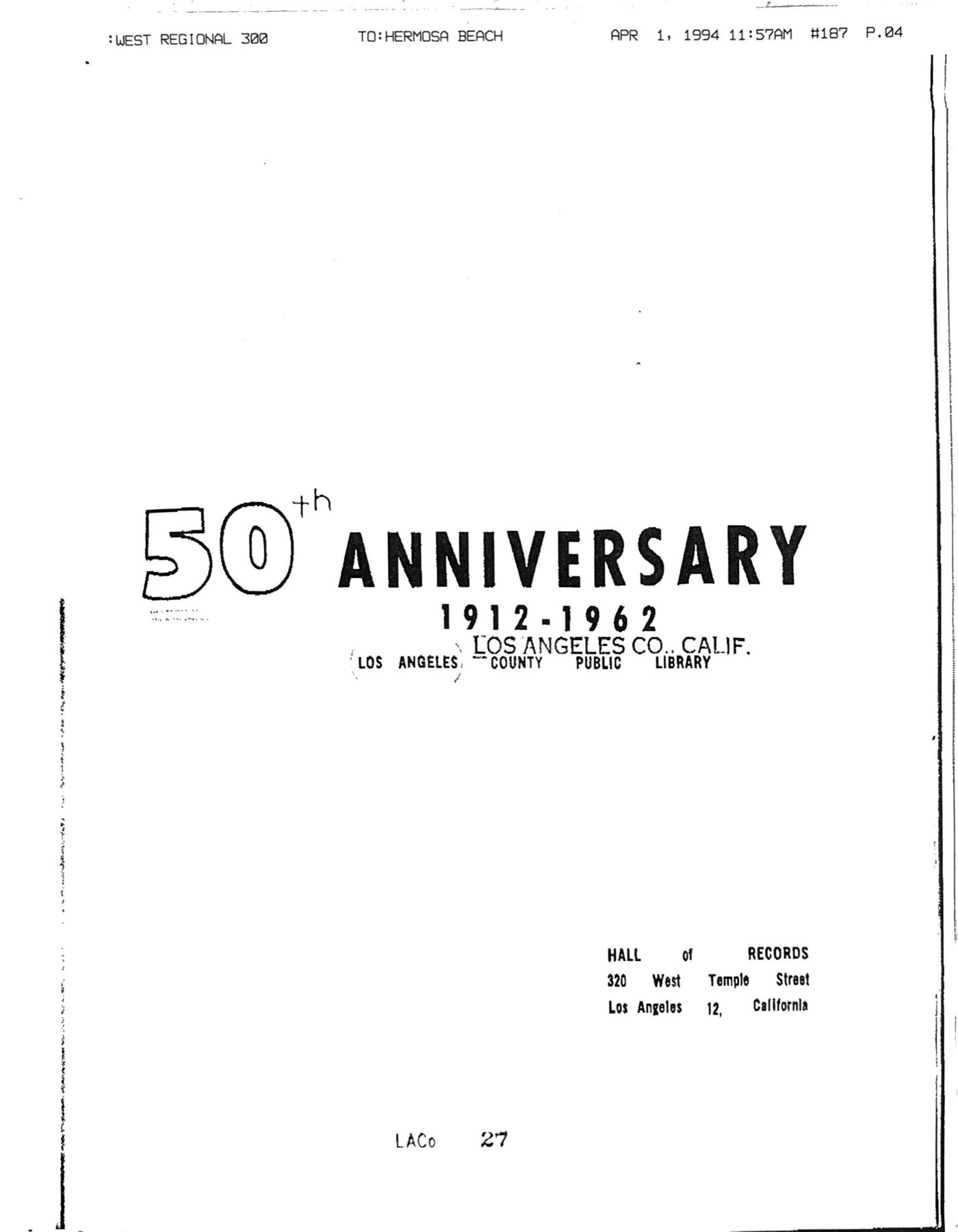
:WEST REGIONAL 300 TO:HERMOSA BEACH APR 1, 1994 11:57AM #187 P.04
50th ANNIVERSARY
1912 - 1962
LOS ANGELES CO., CALIF.
LOS ANGELES COUNTY PUBLIC LIBRARY
HALL of RECORDS
320 West Temple Street
Los Angeles 12, California
LACo 27
Page 2
REGIONAL 300 TO:HERMOSA BEACH APR 1, 1994 11:58AM #187 P.05
HIGHLIGHTS OF COUNTY PUBLIC LIBRARY HISTORY
Los Angeles County in 1912 had a population of 630,000, of which 427,000 lived in the City of Los Angeles. The remainder lived in 29 other cities and in dozens of small unincorporated communities scattered throughout the County. Eighteen of the cities, with a combined population of more than 527,000, had public libraries at the time the Los Angeles County Free Library was founded. These were Alhambra, Azusa, Covina, Glendale, Glendora, Long Beach, Lordsburg (later changed to La Verne), Los Angeles, Monrovia, Pasadena, Pomona, Redondo Beach, Santa Monica, Sierra Madre, South Pasadena, Tropico, Venice and Whittier.
FARMING: THE WAY OF LIFE IN 1912
The City of Los Angeles was the metropolis of Southern California. Most of the other cities and communities were separated geographically from Los Angeles and from each other, and jurisdictional boundaries were much simpler than today when the entire coastal basin has become one great metropolitan community embracing a complex of governmental jurisdictions. Agriculture was then the principal industry and farming was the way of life for most of those who lived in cities and communities outside of the limited metropolitan area of 1912. Although the automobile age was in its infancy, Los Angeles County in 1912 was already well on its way to becoming the community on wheels that it is today, for it had about 38,000 registered motor vehicles and there was already a basic network of County roads and highways.
Having heard from organizations and communities throughout the County, the urgent necessity of providing public library services to the people of the outlying unincorporated territory and in cities which had no libraries had been a major concern of the Board of Supervisors for more than two years prior to the actual establishment of the Los Angeles County Public Library.
JAMES L. GILLIS: MAN OF VISION
James L. Gillis, the California State Librarian, whose vision and leadership were responsible ultimately for the state-wide network of county library systems in California, worked actively toward securing passage of an effective basic county library law. This was accomplished at the 1911 session of the Legislature when the California County Free Library law was passed and went into effect on February 25 of that year. This bill was spearheaded in the Legislature by Assemblyman Stanley Benedict and Senator Leslie Hewitt, both of whom represented Los Angeles County.
Passage of the 1911 law brought about popular demand for library services in Los Angeles County. The first recorded petition filed with the Board of Supervisors requesting establishment of the County Library was signed by H. Kuhl and 30 other residents of the South Santa Anita area on October 9, 1911. This document pointed out that a County Library would "provide splendid opportunities for reading, study and recreation." It was taken under advisement by the Board of Supervisors.
LIBRARY SUPPORT: PUBLIC GROUNDSWELL
In the latter part of November, residents of the City of Tropico submitted a similar petition. These petitions marked the beginning of a groundswell of support for County Library service. In a short time petitions urging that the Library be established and formal endorsements of the proposal were submitted to the Board of Supervisors by residents of San Dimas, Willowbrook and Artesia; by the Watts School PTA; the Trustees of the City of Tropico, the Burbank Chamber of Commerce, a member of the Lordsburg City Council, the Bonita Union High School, the Lordsburg-La Verne Board of Trade, the Burbank Brotherhood of Christian Men, the Watts City Schools, the Compton Pathfinders Club, the City of Glendora, the Claremont Board of Trade, the Social Center Association of the Farmdale School District, and various individual residents of San Dimas, Hermosa Beach and Venice.
On July 22, 1912, the Board of Supervisors firmly indicated its intention to proceed with a County Library by instructing the District Attorney to prepare the necessary legal documents for a public hearing and of its intention to establish a County Free Library in order that provision might be made "for the Library in the next annual tax levy."
5
Page 3
WEST REGIONAL 300 TO:HERMOSA BEACH APR 1, 1994 11:58AM #187 P.06
Although Miss Gleason had not established any branch libraries during her first three months as County Librarian, the records show that she was far from idle. She had visited many cities and communities and had discussed plans for establishing of branches just as soon as books and shelving could be made available. Localities visited the first three months included Willowbrook, Watts, Artesia, Compton, Inglewood, Hermosa Beach, Burbank, Lancaster, Bairdstown, Santa Anita, Arcadia, Glendora, San Dimas, and Lamanda Park. She also had received delegations of citizens and community leaders from many other cities and communities interested in securing books and libraries.
APRIL 23, 1913 FIRST BRANCH
The first branch of the County Free Library was established in Willowbrook on April 23, 1913, in the residence of Mrs. Belle B. Jenks, who agreed to serve as branch "custodian." The Willowbrook branch was classified as a "deposit station" since the home was not large enough to provide a reading room. Mrs. Jenks, who had figured prominently in the efforts to get the County Free Library established, continued to serve as librarian of Willowbrook branch until April, 1945, when she retired. The branch was started with a collection of 50 books and was open initially four hours a week, from 3 to 5 o'clock on Tuesday and Saturday afternoons. In May, 70 more books were added. By June 30 the branch had a total of 63 registered borrowers, 433 books had been circulated and 60 cents in overdue book fines had been collected.
By the end of June, 1913, the County Free Library consisted of 18 branch libraries:
Willowbrook | San Dimas | Lancaster
La Canada | Whittier State School | Hyde Park
Bairdstown | Watts | Hermosa Beach
Burbank | Venice | Compton
Inglewood | Sunnyslope | Artesia
Lamanda Park | South Santa Anita | Arcadia
The book stock of the County Free Library by June 30, 1913 totaled 4,232 volumes, of which 1,827 had been placed in the branches -- for an average of 100 books at each outlet. Total circulation by 367 registered borrowers was 987 from the 18 branches and 27 from the Central Library.
Miss Mary L. Jones was appointed Assistant County Librarian in June, 1913. With a comprehensive background in the field of literature, Miss Jones played an important role in building the Library's book collection during the early years. She was a graduate of the University of Nebraska and had received professional training at the New York State Library School. She served as Librarian, Los Angeles City Public Library, from 1900 to 1905. Miss Jones came to the Los Angeles County Library from Bryn Mawr College, where she had been Librarian for six years.
COMMUNITY SUPPORT POLICY APPROVED
In June, 1913, the Board of Supervisors ratified policy recommended by Miss Gleason governing establishment of branches and a procedure which she had followed to that time. This was to require the local community or city which desired service to support the local branch for the first year, except for the book collection which the County Library provided. After the local branch had completed its probationary period the County Library would then assume all costs, including the salary of the "custodian." This policy insured that the local citizens seriously wanted library service and that the community was willing to do its share with active financial support.
June 30 completed the Library's first fiscal year, although it had been in actual existence only six months. The Board of Supervisors had set a library tax rate of three cents for each $100 of assessed valuation of all taxable property within the County library service area for the first year's operation. This, along with a general fund appropriation for the Librarian's salary, produced a total budget of $42,073. Total of all expenses of this period, including book purchases, salaries, supplies and traveling expenses, was $6,273, which left the Library with a balance of $35,800 with which to face the following year.
7
Handwritten notes
• (left of the heading and in the text) pen outline drawn around the last three paragraphs
• (underline) "Hermosa Beach" underlined in the Venice sentence
• (list of branches) "Hermosa Beach" underlined
• (in text) "Hermosa Beach" underlined in the list of localities visited
Show the original machine reading
Source scan page 18
JM: WEST REGIONAL 300 TO: HERMOSA BEACH APR 1, 1994 11:57AM #187 P.04
50 ANNIVERSARY
1912 - 1962
LOS ANGELES CO.. CALIF
LOS ANGELES COUNTY PUBLIC LIBRARY
HALL 0f RECORDS
320 WestTemple Street
Los Angeles 12, California
LACO 27
Source scan page 19
WEST REGIONAL 300 TO: HERMOSA BEACH APR 1, 1994 11:58AM #187 P.Ø5
HIGHLIGHTS OF COUNTY PURLIC LIBRARY HISTORY
of
ed
e
County. Los Angeler County in 1912 had a population of 630,000, of which 427, 000 lived in the City of
Los Angeles.The remainder lived in 29 other cities and in dozens of small unincorporated com-
munities scattered throughout the County. Eighteen of the cities, with a combined population of more
than 527,000, had public libraries at the time the Los Angeles County Free Library was founded.
These were Alhambra, Azusa, Covina, Glendale, Glendora, Long Beach, Lordsburg (later changed
to La Verne), Los Angeles, Monrovia, Pasadena, Pomona, Redondo Beach, Santa Monica, Sirra
Madre, South Pasadena, Tropico, Venice and Whittier.
The City of Los Angeles was the metropolis of Southern California,
FARMING: THE WAY
OF LIFE IN 1912
Most of the other cities and communities wete separated geographi-
cally from Los Angeles and from each other, and jurisdictional
boundarics were much simpler than today whenthe entire coastal basin has become one great metro-
politan community embracing a complex of governmental jurisdictions. Agriculture was then the
of life for most of those who lived in citics and com-
principal industry and farming was the way
munities outside of the limited metropolitan area of 1912. Although the automobile age was in its
infancy. Los Angeles County in 1912 was already well on its way to becoming the community on
wheelsthat it is today, for it had about 38, 000 registered motor vehicles and there was already a
basic network of County roads and highways.
Having heard from organizations and communities throughout the County, the urgent necessity
and in
of providing public library services to the peopie of the outlying unincorporated territory
cities which had no libraries had been a major concern of the Board of Supervisore for more than
two years prior to the actual establishment of the Los Angeles County Public Library.
James L. Gillis, the California State Librarian, whose vleion and
JAMES L. GILLIS:
MAN OF VISION
leadership were responsible ultimately for the state-wide network of
county library systeme in California, worked actively toward securing
passage of an effective basic county library law. This was accomplished at the 1911 session of the
Legislature when the California County Free library law was passed and went into effect on Febru-
ary 25 of that year. This bill was spcarheaded in the Icgislature by Assemblyman Stanley Benedict
and Senator Leslie Hewitt, both of whom represented Los Angeles County.
Passage of the 1911 law brought about popular demand for library services in Los Angeles
The first recorded petition filed with the Board of Supervisore requesting establishment of the County Library was signed by I. Kuhl and 30 other residents of the South Santa Anita area on
October 9, 1911. This document pointed out that a County library would "provide splendid oppor-
tunitics for reading, study and recreation," It was taken under advisement by the Board of Super-
visore,
In the latter part oi November, residente of the City of Tropico sub-
LIBRARY SUPPORT:
PUBLIC GROUNDSWELI.
mitted a similar petition. These petitions marked the beginning of a
groundswell of support for County Library service. In a short time
petitions urging that the Library be established and formal endorsements of the proposal were Bub-
mitted to the Board of Supervisors by residents of San Dimas. Willowbrook and Artesia; by the
Watts School PTA; the Trustees of the City of Tropico, the Burbank Chamber of Commerce, a mem-
ber of the Lordsburg City Council, the Bonita Union High School, the Lordsburg-Ja Verne Board of
Trade, the Burbank Brotherhood of Christian Men, the Walls City Schools, the Compton Pathfinders
Club, the City of Glendora, the Claremont Board of Trade, the Social Center Association of the
Farmdale Schoul District, and various individual rosidents of San Dimas, Hermosa Beach and
Venice.
On July 22, 1912, the Board of Supervisors firmly indicated its intention to proceed with &
County Library by instructing the District Attorncy to prepare the necessary legal documents for a
public hearing and of its intention to establish a County Frce Library in order that provision might
be made "for the Library in the next annual tax levy."
Source scan page 20
ch
08
???
10T
B$-
by
111-
d-
of
'e-
i on
?T -
ed,
he
ith
? ly
id
ed
aty
5.
*: WEST REGIONAL 300 TO: HERMOSA BEACH APR 1, 1994 11:58AM #187 P.06
Although Miss Gleason had not cstablished any branch libraries during her first three months
46 County librarian, the records show that she was far from idle. She had visited many cities and
communities and bad discussed plansfor establishing of branches justan soon as booke and shelving
localities visitod the first three months included Willowbrook, Watts,
could be made available.
Hermosa Beach, Burbank, Lancaster, Bairdstown, Santa Anita,
Artesia, Compton, Inglewood,
Arcadia, Glendora, San Diman, and Lamanda Park. She also had received delegations of citizens
and community leaders from many other cities and communitics interested in securing books and
libraries.
The first branch of the County Free Library was established in
APRIL 23, 1913
Willowbrook on April 23, 1913, in the residence of Mrs, Belle B.
FIRST BRANCH
Junks, who agreed to serve as branch "custodian." The Willowbrook
branch was classificd as a "deposit station" since the home was not large crough to provide & reading
room. Mrs. Jenks, who had figured prominently in the efforts to get the County Free Library es-
tablished, continued to serve as librarian of Willowbrook branch until April, 1945, when she retired.
The branch was started with a collection of 50 books and was open initially four hours a week, from
3 to 5 o'clock on Tuesday and Saturday afternoons. In May, 70 more booke were added. By June 30
the branch had a total of 63 registered borrowers, 433 booke had been circulated and 60 cents in
overdue book fines had been collected.
By the end of June, 1913, the County Free Library consisted of 18 branch libraries:
Willowbrook
I.a Canada
Bairdstown
Burbank
Inglewood
Lamanda Park
San Dimas
Whittier Statc School
Watts
Venicc
Sunny slope
South Sanla Anita
Lancaster
Hyde Park
Hormoa Beach
Compton
Arteria
Arcadia
The book stock of the County Frec Library by June 30, 1913 totaled 4,232 volumes, of which
1,827 had been placed in the branches -- for an average of 100 booke at each outlet. Total circu-
lation by 367 registered borrowers was 987 from the 18 branches and 27 from the Central Library.
Miss Mary L. Jones was appointed Assistant County Librarian in June, 1913. With a com-
prehensive background in the fleld of literature, Miss Jones played an important role in building
the Library's book collection during the carly years. She was a graduate of the University of Ne-
braska and had received professional training at the New York State Library School. She served as
Librarian, Ios Angeles City Public Library, from 1900 to 1905. Miss Jones came to the Los
Angeles County Library from Bryn Mawr Colleg, where she had been Librarian for six years.
In June, 1913, the Board of Supervisors ratified policy recommended
COMMUNITY SUPPORT
by Miss Gleason governing establishment of branches and a procedure
POLICY APPROVED
which she had followed to that time. This was to require the local
community or city which desired service to support the local branch for the first year, except for
the book collection which the County Library provided. After the local branch had completed its
all costs, including the salary of the
probationary period the County Library would then assume
"custodian," This policy insured that the local citizens seriously wanted library service and that
the community was willing to do its share with active financial support.
June 30 completed the library's first fiscal year, although it had been in actual existence
only six months. The Board of Supervisors had set a library tax rate of threo cents for each $100
of assessed valuation of all taxable property within the County library service area for the first
year's operation. This, along with a general fund appropriation for the Librarian's salary, pro-
duced a total budget of $42,073. Total of all expenses of this period, including book purchases,
salaries, supplies and traveling expenses, was $6,273, which left the Libraty with a balance of
$35,800 with which to face the following year.